
Give it sun
Centipede needs at least 6 hours of full sun a day. Under heavy shade it thins out no matter how it is fed.
Grass guide · Centipede
Centipede grass needs only 1 to 2 pounds of nitrogen per 1,000 square feet a year, split into two feedings: one in early May after it has fully greened up, and one in late summer. Feeding it more than that is how Centipede lawns get into trouble.
Clemson's calendar
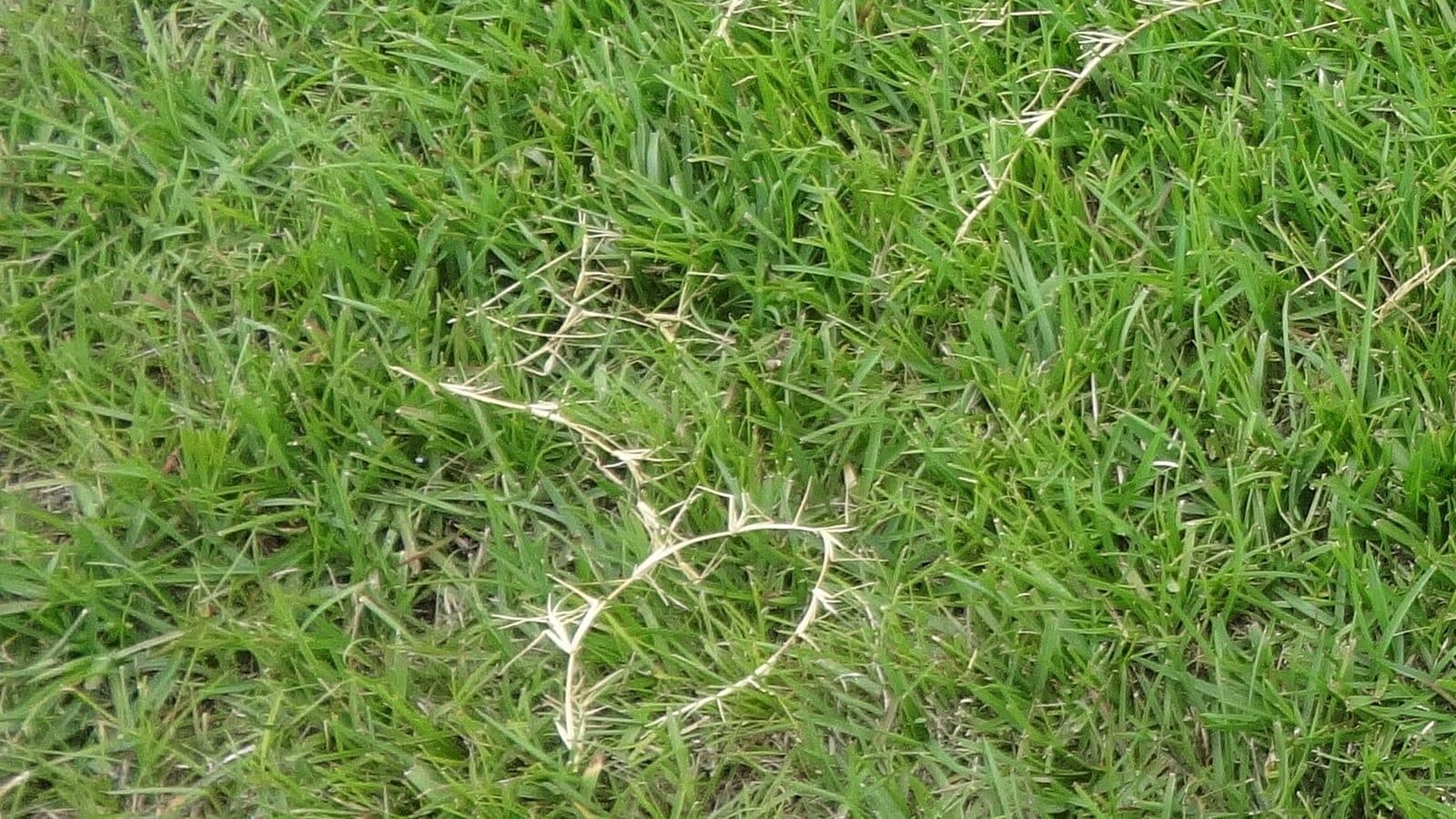
Centipede is naturally a light, apple green. Feeding it to look darker is where the trouble starts.
| When | Nitrogen per 1,000 sq ft | What to do |
|---|---|---|
| January to AprilWhile the lawn is brown | Nitrogen per 1,000 sq ftNone | What to doNo nitrogen yet. A late frost burns back early growth. Good time for a soil test. |
| Early MayOnce it is fully green | Nitrogen per 1,000 sq ft½–1 lb | What to doFirst feeding. Skip phosphorus unless a soil test calls for it. |
| Between feedingsOnly if it looks yellow | Nitrogen per 1,000 sq ftNone | What to doIron, not more nitrogen: 2 ounces of iron sulfate in 3 to 5 gallons of water per 1,000 square feet, under 80°F, watered in. |
| Late summerBy mid-August | Nitrogen per 1,000 sq ft½–1 lb | What to doSecond and last feeding, with a high-potassium fertilizer like 15-0-15. |
| September to DecemberGoing dormant | Nitrogen per 1,000 sq ftNone | What to doNo nitrogen. Potash only if a soil test says it is low. |
That is 1 to 2 pounds a year, the whole range for Centipede. There is no room for a third feeding or a weed-and-feed on top.
The Midlands difference
Centipede needs at least 6 hours of full sun a day. Under heavy shade it thins out no matter how it is fed.
Sandy soil takes 2 pounds a year and clay takes 1. In deep sand, tiny soil worms (nematodes) also thin Centipede, and more fertilizer will not fix that.
Centipede likes its soil more acidic than most lawn grasses do, about pH 5.5 to 6.0, so lime sized for Bermuda or Zoysia can take it too high. Yellowing is usually iron, not nitrogen. A soil test tells you which way yours is off, and whether it needs lime, sulfur or neither.
Questions
Sources: Clemson Cooperative Extension, Home & Garden Information Center: Centipedegrass Yearly Maintenance Program (HGIC 1215), Fertilizing Lawns (HGIC 1201), Centipedegrass (HGIC 1209). Last checked in September 2026.
Photo: Michael Rivera, University of Georgia Research and Education Garden, licensed CC BY-SA 4.0, cropped.
Two light feedings at the right time, nothing extra in between, and weeds handled on the same schedule. Send us the address and we will quote the 7-Step Program for your Centipede.
